
Reflecting on the Bowdoin Students for Justice in Palestine encampment, one year later
February 27, 2026
 Miles Berry
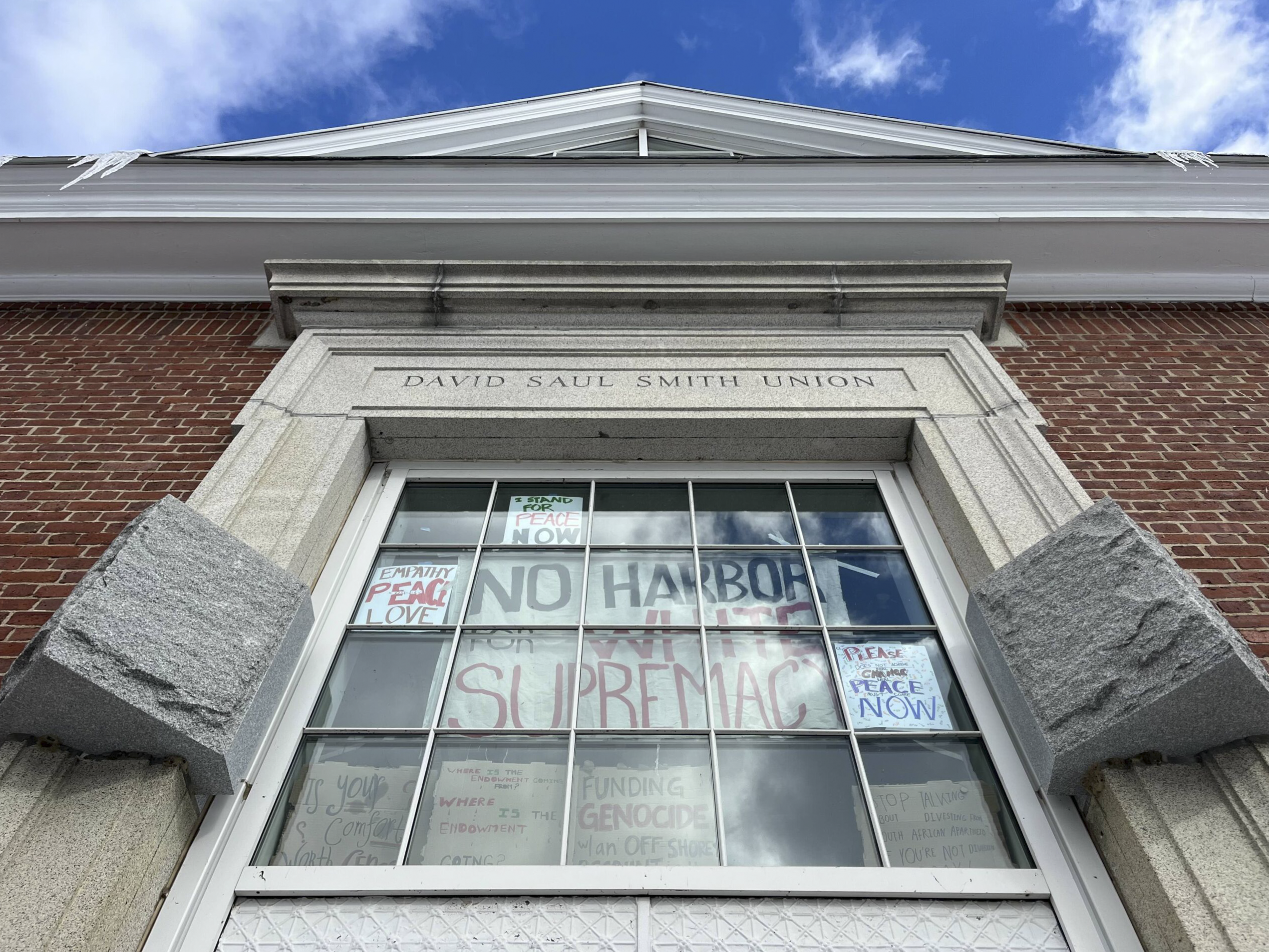
On the evening of February 6, 2025, organizers of Bowdoin Students for Justice in Palestine (SJP) held a rally at the Polar Bear statue, passing around a megaphone and delivering speeches criticizing the Trump administration and the College for their respective responses to Israel’s war on Gaza. Protestors then entered Smith Union, where they erected tents and hung signage inside.
This marked the start of the SJP-led encampment that would last a total of four days and leave long-lasting effects on the Bowdoin community, including overhauls of College policy and an investigation into the College by a Republican-led House of Representatives Committee. The encampment drew mixed reactions at the time and continues to in recollections and desires to move forward one year later.
The prelude
The encampment emerged nearly a year after Bowdoin students voted in favor of the SJP-organized Bowdoin Solidarity Referendum in early May 2024. The resolution demanded that the College take an institutional stand against “scholasticide” in Gaza, disclose its exposure to investment in arms manufacturing companies, cease future investments in defense-focused funds and instate an independent committee to oversee social responsibility in the College’s investments.
Soon after the referendum’s passage was announced, President Safa Zaki wrote an email to the campus community denying the referendum’s request for an institutional statement on Gaza. In response to the referendum’s other three demands, Zaki proposed that the Board of Trustees hear from students both supporting and opposing the referendum to deliberate the referendum’s remaining requests.
In September 2024, the College established the Ad Hoc Committee on Investments and Responsibility (ACIR) in response to the referendum, consisting of Bowdoin faculty, staff, students and trustees.
In an email to the campus community, Zaki noted that the ACIR would not make recommendations regarding the referendum specifically but rather propose general guidelines for how the College could navigate potential changes to its investment practices. She also wrote that the committee would make recommendations by the end of the semester unless the committee decided to extend this deadline.
In October 2024, the ACIR held a series of listening sessions in its first major public action since formation. In interviews with The Bowdoin Orient at the time, students voiced mixed feelings regarding the receptiveness of the committee and structure of the sessions.
During a subsequent meeting of the Board of Trustees, SJP organized a sit-in outside of the Trustees’ plenary session to protest the lack of transparency they experienced at the ACIR’s listening sessions. Former BSG President and SJP leader Eisa Rafat ’25, who was invited to this meeting, walked out in protest shortly after its commencement.
By February of the following spring semester, the College had yet to alter its investment practices in line with the demands of the referendum.
Shutdown in Smith Union
Days before the encampment took place, U.S. President Donald Trump announced plans during a conference with Israeli Prime Minister Benjamin Netanyahu to “permanently resettle” the more than two million Palestinian residents of the Gaza strip.
On February 6, following SJP’s rally by the Polar Bear statue, students entered Smith Union and began erecting tents and signage, including a Palestinian flag and a “Shaban al-Dalou Union” banner, referencing SJP’s renaming of the building after a 19-year-old Palestinian college student killed by Israel’s bombing of the Al-Aqsa hospital in Gaza. At the start of the encampment, an estimated 50 students and 11 tents occupied the Union.
Soon after, SJP published an official press release outlining the goal of the encampment, which was to see the demands of the Bowdoin Solidarity Referendum enacted.
“Today, as the Bowdoin Board of Trustees convened for their tri-annual meeting, [SJP] launched the Shaban al-Dalou Union encampment,” SJP wrote. “This move comes in response to a blatant months-long stalling campaign by the College to avoid implementing the demands of the Bowdoin Solidarity Referendum.… Today, we launch this encampment, demanding that Bowdoin immediately commit to fully realizing all four demands of our referendum.”
A few hours later, former Associate Vice President of Safety and Security Randy Nichols and Senior Associate Dean for Student Affairs Katie Toro-Ferrari told protestors to leave the encampment by 1 a.m. the next day or risk facing consequences.
Despite the directive, many students remained in Smith Union, spending the night in tents.
The following morning, February 7, Security officers stationed at both main entrances to Smith Union informed people that the building was closed. According to the College’s Office of Communications and Public Affairs’ Smith Union Encampment FAQ page, the decision to close Smith Union was motivated primarily by concerns about the arrival of outside supporters and opponents of the protest.
Just before 6 p.m. on February 10, the encampment ended as the last protestors exited Smith Union to a large, cheering crowd gathered by the south entrance. SJP leaders noted that College administrators did not ultimately accede to the demands of the referendum but had agreed to “a context of good faith” in handling the protesters’ disciplinary processes.
The Smith Union Encampment FAQ page highlights that the College did not negotiate a deal to end the encampment.
“In conversations that led to the end of the encampment, the College told the students remaining in the encampment that it would acknowledge certain facts about the situation, including that the interactions between the students involved in the encampment and the administration included respectful dialogue; that the students left voluntarily; and that the College made the decision to close the union,” the page reads.
The immediate aftermath
The encampment garnered the attention of many around Maine. The Portland Press Herald published multiple articles about the encampment, and the Orient’s Opinion section received many articles about the encampment and the College’s response, including from parents of alumni.
Days after the encampment ended, approximately 50 students faced disciplinary action for their involvement in the protest. Of this group, eight were temporarily suspended, barring them from campus services and housing. Formal hearings for these eight students occurred the next week. All eight were placed on disciplinary probation on February 23, allowing their return to campus.
That same week, SJP was suspended by Student Activities.
The Smith Union Encampment FAQ page lists College rules and policies that were violated during the encampment.
“Bowdoin’s Academic Honor Code and Social Code does not permit the use of college facilities in a way that disrupts the normal operations of the College or is otherwise counter to the security and safety of others,” the page reads. “It also requires students to comply with the reasonable request of a college official or faculty member. Additionally, the Social Code contains rules that bar unauthorized entry into or occupation of a work area or social facility, among other spaces, and prohibits conduct that restricts or prevents employees from performing their duties.”
On February 28, roughly two weeks after the encampment ended, the ACIR released its final report. The report, which was approved by the Board of Trustees the previous week, recommended that the College maintain its existing investment practices, advised against creating a social responsibility committee for the endowment and recommended greater transparency around the College’s financial model and the role of the endowment in advancing the College’s academic mission.
The report also estimated that exposure to the ten defense and aerospace companies named in the Bowdoin Solidarity Referendum amounted to approximately 0.08 percent of the endowment held as part of portfolio funds.
On March 7, in a campuswide email titled “Working Together,” Zaki outlined steps that administrators would take to facilitate conversation on campus, including “ask us anything” programs with its senior officers, a new committee to review speech and expression policies and a campuswide series on contemporary challenging topics.
Today’s legacy
Since launching last March, Zaki’s “Working Together” initiative has developed additional programs. A dedicated page on the College’s website describes these, including a Bowdoin Community Conversation Fellowship that aims to facilitate dialogue and a “Disagreeing Together Over Dinner” series for first-year students.
These programs have received mixed feedback from members of the College community. At a forum to gather feedback for the College’s Viewpoint Exchange speaker series program, some students expressed hope that the program would include more perspectives, including a Palestinian speaker.
The Committee on Postering, Building Use and Demonstrations was formed in April of 2025, leading to the development of new rules on postering, staff and faculty organizations and protests that disrupt “normal College operations,” among other topics.
On Tuesday, after notable criticism from the College community, Senior Vice President and Dean for Academic Affairs Jen Scanlon wrote to the campus community announcing various edits that clarified these policies.
Senior Vice President and Dean for Student Affairs Jim Hoppe, who led the committee alongside Scanlon, commented on the committee’s relation to the encampment and the new policy change in an email to the Orient.
“The idea for creating this type of committee was actually born before the encampment.… The plan was to create this type of committee to tackle the question of postering/publicity on campus,” Hoppe wrote. “When similar questions were raised about other policies, we broadened the scope when the committee was created to include not only postering, but also space use and demonstrations and protests.”
In an email to the Orient, Associate Vice President of Safety and Security Bill Harwood commented upon the interplay between student protest and security.
“The Office of Safety and Security is committed to a campus environment where both safety and freedom of expression are protected. We are proud of the ways that we are able to work with our community to ensure this happens, and have always encouraged students, and all community members, to work with us on any events that they are planning on campus,” Harwood wrote.
The encampment also drew attention from those outside the Bowdoin community. On March 29, 2025, the House of Representatives’ Committee on Education and Workforce sent a letter to Zaki and Chair of the Board of Trustees Scott Perper expressing concern that the College had failed to protect its Jewish students during the encampment.
The letter demanded various documents, including those detailing disciplinary action taken against students or faculty involved in the encampment, setting an April 10 deadline which passed with no update from the College.
On June 2, a follow-up letter from the committee accused the College of noncompliance. Since then, there have been no additional updates on the congressional investigation.
Senior Vice President for Communications and Public Affairs Martin Mbugua and Director of Communications Doug Cook both declined to comment when asked about the status of the congressional investigation.
Following the completion of a formal disciplinary process, SJP was dechartered as a student group.
Amnesty Bowdoin, a student group which has framed itself as a successor to SJP, was chartered at the start of this academic year.
In an email to the Orient, Amnesty Bowdoin co-founder Jules Messitte ’26 reflected on what the organization learned from the encampment and the dechartering of SJP.
“We underestimated the extent to which the College’s ‘listening’ is an illusion. When [Hoppe] entered the encampment to talk about what encampment participants wanted, he admitted that he didn’t know what the referendum asked. We were amazed by how little the word of administrators means. Of the promises that [Zaki and Scanlon] made at the end of the encampment, they kept none,” Messitte wrote.
Messitte additionally expressed frustration at what he described as the College administration’s willingness to kowtow to the Trump administration’s demands.
“Their eagerness to sacrifice the College’s stated values to appease the Trump administration continues, as we can see with the new set of policies [Hoppe] laid out in January to restrict student expression and assembly,” Messitte wrote.
Asked what the future of human rights and pro-Palestinian activism at Bowdoin looks like, Messitte responded with a call to action.
“Positive change at Bowdoin has always been led by its students, faculty and staff,” Messitte wrote. “We are more than just the moral backbone of this College—we are its beating heart. Without us, there is no Bowdoin. Together, we could make it impossible for the administration to hide behind its strategic delay and performative listening. The question is whether students, faculty and staff are ready for collective action.”
Cedar Greve ’26 participated in the encampment as a member of SJP. They warned against fixating on the encampment itself rather than the context that sparked it.
“I think it’s dangerous to valorize the encampment or focus specifically on the experience of the encampers, because that was not the reason we were there protesting. Having an encampment is not unique. We were building on a long tradition across college campuses and the world, and the focus should always remain on the reason why we were there,” Greve said. “The reason we were there was the liberation of the Palestinian people.”
Greve responded with mixed sentiments about the encampment’s success.
“Obviously the College has yet to meet the material demands of the [Bowdoin Solidary Referendum], which was our strong motivation for being in there, and I of course am disappointed in that response,” Greve said. “But I also think that a large political action on a largely apathetic and politically dormant campus is not something to be overlooked, in addition to the connections that were built with the community in Maine and people who showed up on campus.”
Following the conclusion of the 2025–26 academic year, SJP will be eligible to recharter. The Smith Union Encampment FAQ page notes that this is contingent on “the group [demonstrating] how it will address its violations of policies and [working] in good faith with college staff about planned programming.” Greve shared that SJP is attempting to do so.
“We’ve begun talking with admin about rechartering SJP in the coming year,” Greve said. “I think just because we were dechartered doesn’t mean that the need to organize or the desire to organize our energy on campus has stopped existing. Obviously I can’t, or won’t, say anything terribly specific, but there is more to come.”
Comments
Before submitting a comment, please review our comment policy. Some key points from the policy: