
Professor Aviva Briefel launches book exploring supernatural and material culture in the Victorian era
January 23, 2026
 Kiran Elfenbein
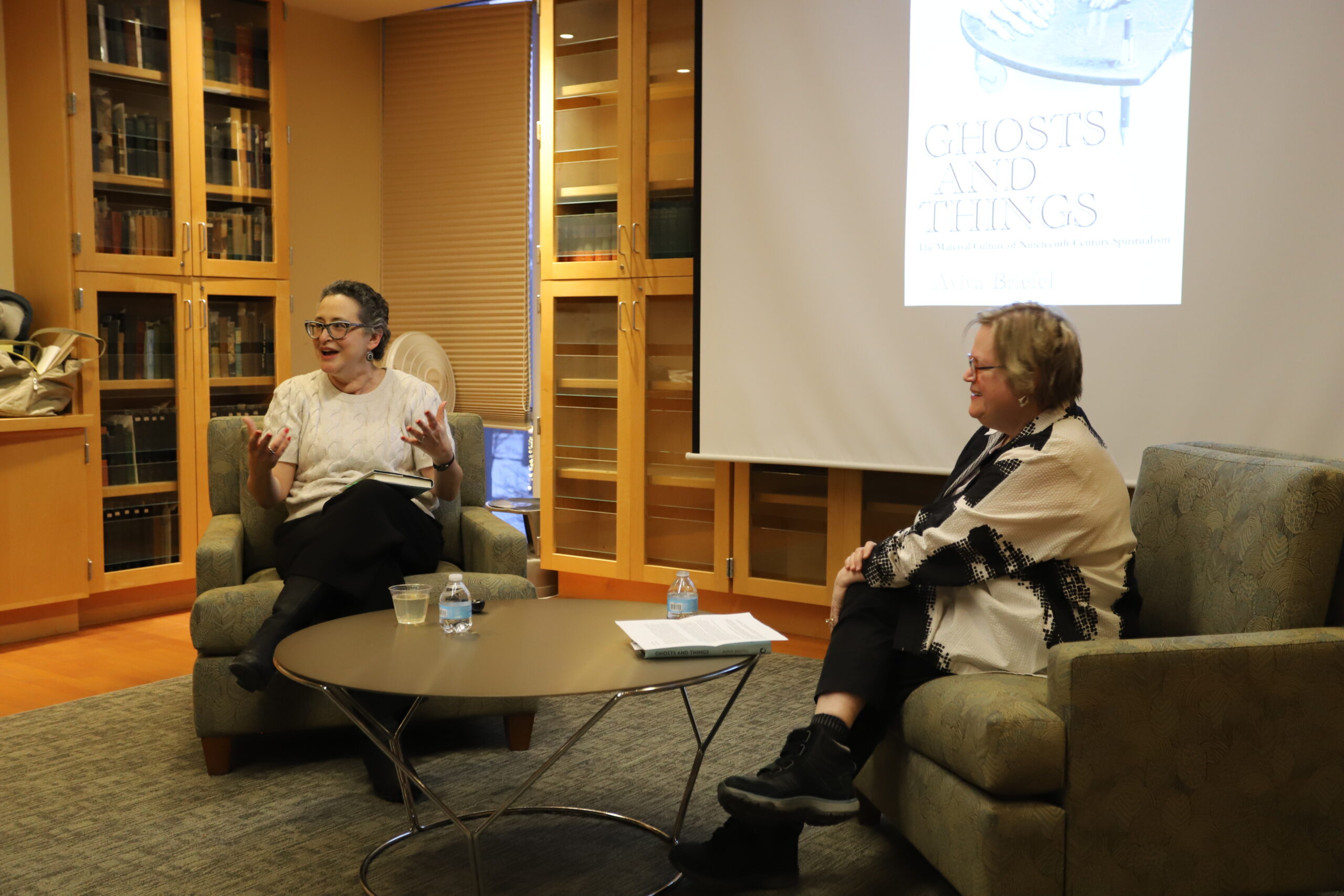
Students and community members gathered Thursday at the Hawthorne-Longfellow Library (H-L) to celebrate the launch of English and Cinema Studies Professor Avivia Briefel’s latest book. “Ghosts and Things: The Material Culture of Nineteenth-Century Spiritualism” deals with the spiritualist movement of the 19th century, particularly what this movement demonstrates about the increasingly capitalistic society in which it gained popularity. Briefel was joined by Associate Professor of English Ann Kibbie in discussing everything from seances to supernatural cabinets of curiosities.
Briefel, a scholar of Victorian literature and culture, first conceptualized the project when considering the origins of spectral clothing.
“I really started thinking about the question of materiality and ghosts,” Briefel said. “We think of ghosts as being ethereal and immaterial, but the only way they had to communicate with people in the 19th century was through objects.”
She quickly found connections between the material nature of ghosts and the growing industrialism of the period.
“They had theories about how these ghosts made their own bodies, produced these synthetic materials, in processes that were like mechanical reproduction of electrotyping,” Briefel said.
These connections brought Briefel to begin the challenge of sorting through countless spiritualist testimonies and periodicals. Eventually, Briefel set a rule for herself, which is outlined in the introduction of her book: She would not pass any judgment regarding the legitimacy of the supernatural experiences she described.
“Whether it’s a position of belief or skepticism, I thought the best way was to step back and look at how people describe these phenomena from both of these perspectives,” Briefel said.
Briefel’s archive covers everything from the origins of spiritualism with the Fox sisters in New York to famous supernatural performances, such as the Davenport brothers and their massively successful “cabinet seances.” Briefel asserts that these cabinet seances may have been influenced by a very different kind of performance: Henry Brown’s escape from enslavement by hiding inside a box and shipping himself to abolitionists in Philadelphia in 1849.
“[Brown] and also the anti-slavery representatives who promoted his case really talked about it as a resurrection. It’s as if he had come back from the dead. Here he was, boxed in something that was very much like a coffin for miles and miles and days and days, and then it was like a miracle. There’s this miraculous kind of parallel. And so I think that that’s also part of the ta-da of the Davenport brothers and then later magicians,” Briefel said.
Briefel connects spiritualism to capitalism through similar connections between consumption and production, whether through performance or meaning in the material. An interest in the immaterial acts as a means of coping with an increasingly materialistic world.
“The only way that meaning was produced in these seances, because we can’t see or feel the immaterial, was through material manifestation—often through objects and ghost bodies—which were also objects because they made their own bodies,” Briefel said. “I think about the seance room as this little laboratory for thinking about different questions raised in the big world of capitalism where things are often invisible, as well our relationship to production, to the world of things, is often really abstracted.”
Briefel sees this 19th-century spiritualism echoed in the mainstream even today, where society’s fascination with the macabre and supernatural has hardly waned—a fascination that continues to present new and developing moral dilemmas, particularly regarding which stories are told and which are not.
“How many shows are there on TV where it’s haunted spaces linked to historical events?” Briefel said. “And sometimes in very problematic ways, like in certain slave plantations…, ‘the ghost of this enslaved person still haunts it,’ which is a way of also rewriting and masking certain parts of history, of what are the actual quarrels that took place there.”
Briefel’s work underscores that the urge to communicate with the supernatural as a means of understanding the present remains in society, as she described a visit to the tomb of a 19th-century spiritualist where mediums and believers still stood by in reverence.
“This is still powerful,” Briefel said. “This is still something that, for a lot of people, is still happening.”
Comments
Before submitting a comment, please review our comment policy. Some key points from the policy: