
Community lecture series explores “ambulatory Gothic” in various horror films
December 5, 2025
 Addison Moore
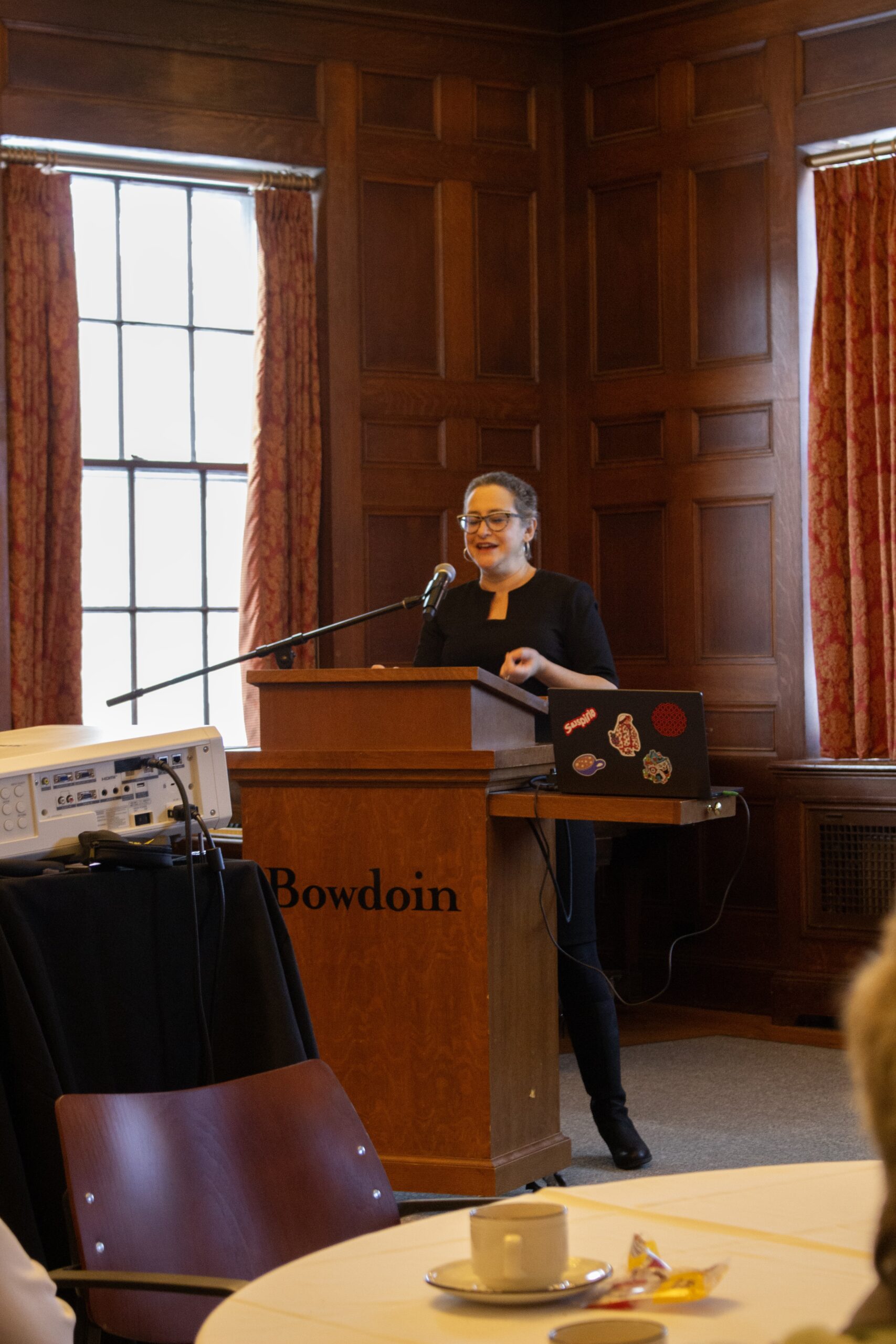
On Thursday, a crowd gathered in Moulton Union’s Main Lounge for a lecture titled “Ambulatory Gothic: House Tours in the Horror Film” by Edward Little Professor of the English Language and Literature and Cinema Studies Aviva Briefel. Briefel’s talk was sponsored by the Association of Bowdoin Friends, of which many members were present.
Briefel began by establishing that, in many pieces of horror media, which would be cited throughout the lecture, the story begins with characters walking through a new home, hotel or apartment. Beyond orienting the characters, these tours guide the audience toward understanding the greater premise or significance of the film.
Briefel highlighted Jordan Peele’s 2017 horror and mystery film “Get Out.” In an interview with the Orient, Briefel remarked on the importance of this film on her research.
“I’ve seen the film [‘Get Out’] a million times, and what always stays in my head is the tour at the beginning,” Briefel said.
This tour, featuring a mysterious sealed basement, inconspicuous souvenirs and family photos, foreshadows the movie’s thematic focus on racism and later plot twists.
Although “Get Out” provides a modern example of the house tour trope, Briefel traces the motif back to 18th- and 19th-century Gothic literature, with works such as “Jane Eyre” featuring a similar device for readers.
In literature and film alike, house tours in horror media help readers know what to pay attention to. Reflecting on tours in writing, Briefel described how they often revolve around real-estate visits, job placements, paranormal investigations or marriage and otherwise romantic plots.
Briefel noted other films including the types of tours she introduced. The lecture featured a clip from the 1979 film “The Amityville Horror” in which a couple, alongside a real-estate agent, tours a house for sale where, the year prior, a family had been murdered. Flashes of the killings appear during the tour, informing the audience of the house’s significance during the tragic events.
The 1968 horror movie “Rosemary’s Baby” also features a house tour. As another couple tours an apartment for sale, the audience is shown strange details in the apartment alongside normal maintenance problems, such as a blocked closet and a repaired peephole.
Lastly, in a horror classic, “The Shining,” the characters residing at the Overlook Hotel repeatedly “tour” the hotel to gain a better understanding of their surroundings. The hotel acts as a labyrinth inseparable from the terror of the Gothic film.
Briefel concluded by emphasizing that these tours give audiences the ability to decide what is important about the film’s setting while building anticipation. She then opened the floor to audience members for questions.
Audience members were curious as to whether horror films of a certain quality convey the house tour better than others. Briefel argued many horror films may be dismissed by critics in spite of their strengths and that many films use the tour trope effectively and uniquely.
Electronic Resources and Scholarly Communications Librarian Kate Wing is not typically a horror fan but appreciated Briefel’s perspective on the genre.
“I don’t generally like horror, but this made me interested in maybe seeing some films that are more horror-like,” Wing said.
Talk attendee Allison Adams, who is studying Gothic literature at Trinity College Dublin, appreciated the lecture’s connection to her studies.
“Seeing another angle of the Gothic explored, I find very, very interesting,” Adams said.
Briefel’s reflection on horror house tours revealed their value to the genre, resonating with a diverse range of audience opinions.
“The ambulatory teases out the relationship between narrative structure, architectural space and the acquisition of knowledge for both characters and spectators,” she said. “The trope represents a new way of understanding how Gothic narratives draw us into worlds marked by menace and violence, while forcing us to consider which forms of menace and violence are especially worthy of our attention.
Comments
Before submitting a comment, please review our comment policy. Some key points from the policy: