
Portrait of an Artist: Carolina Bragg ’26
January 23, 2026
 Sebastian Sahlman
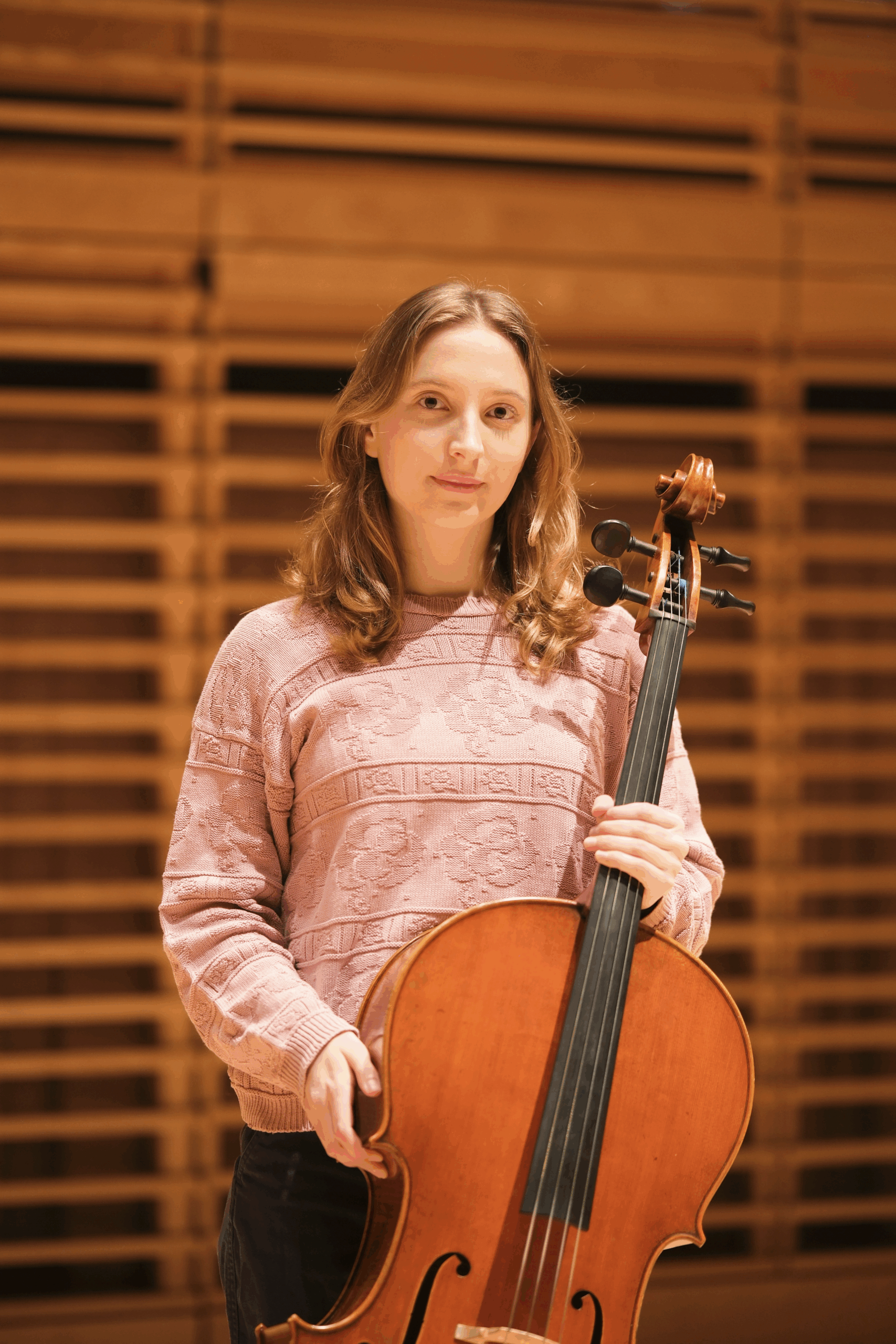
For Carolina Bragg ’26, music has always been a family affair.
At a young age, she followed her sister’s example and started playing the cello. Later, her sister became the first one in the family to start writing music.
“Naturally, I followed in her footsteps,” Bragg said.
When she was in high school, Bragg began composing on the cello just by improvising and being creative.
“[My sister and I] were both huge nerds, particularly book nerds, and I find that a lot of my inspiration for pieces comes from novels and poetry. So it’s good to be able to nerd out with your sister and then write music about it,” Bragg said.
At Bowdoin, Bragg has continued to compose. Taking inspiration from written works is something that she has done a lot in her composing, she says, recounting how one of the first pieces that she wrote for string quartet was based on “Paradise Lost.”
“I like to think in the concrete world of, ‘Okay, what is the visual landscape, and what does that sound like?’ I know a lot of composers that I admire are a lot more abstract in their thinking, and they’re using emotions and abstract things like that. I like to ground things in the world. I also spend a lot of time, as a biology major, being outside and doing research on the natural world,” Bragg said. “That is very much part of what I’m thinking about all the time.”
In order to turn words into music, Bragg thinks about factors like rhythm and texture. She described a poem by a indigenous Mi’kmaq writer that she is currently turning into a musical piece.
“[This poem] is about the logging industry,” Bragg said. “It’s in northern Maine, and they are chopping down huge trees and letting these logs flow down the river. And that’s a really cool visual, and it gets me thinking, ‘Okay: darkness, the woods, wind, water. What does that sound like? How can instruments replicate that?’”
Composing music has also meant that Bragg has the unique opportunity to see her pieces performed by others. Though it never turns out exactly the way she envisioned it at first, she explains that’s part of what makes it so magical.
“It’s like, this isn’t how I would have whispered it into my [GarageBand] mic when I was first drafting this, but it is so cool to see how someone else interprets it and what sticks out to people because it’s almost never what I expect. But that is the best part,” Bragg said.
Last year, Bragg saw one of her pieces performed at National Sawdust, a venue in Brooklyn, N.Y. She has also been able to play her compositions on a more informal level at Bowdoin.
“Just writing duets with cellists I know here and playing those … is also super fun because it is so rewarding when someone wants to participate in that with you. The fun of it is you get to improvise and be creative, and it doesn’t always have to be super formal,” Bragg said.
Bragg’s musical experience at Bowdoin has also included the symphony orchestra, which she has participated in since her first year on campus.
“I feel like there’s just so many fun ways that the orchestra gives back to Bowdoin, and it’s just always such a great time to be at rehearsal,” Bragg said.
For Bragg, this sense of community and collaboration is also something that she has found in composing, especially when she is working on pieces that are based on poems.
“I think with composing, I’m always trying to tell an interesting story, and I always want to be collaborative with the poet I’m working on. I see it as, even though … the piece itself is mine, it really is inspired by her. So I see it as a joint product,” Bragg said.
After Bowdoin, Bragg says that composing is something that she wants to continue, even just casually.
“I think it’s just a good exercise,” Bragg said. “It’s a muscle that you want to keep going, even if you don’t have the formal opportunity to do that all the time.”
Comments
Before submitting a comment, please review our comment policy. Some key points from the policy: