
Buried under history: Revisiting Bowdoin’s Winter’s Weekend snow sculpture tradition
January 30, 2026
 Courtesy of the George J. Mitchell Department of Special Collections & Archives
For much of Bowdoin’s history, winter was not something to be endured by students alone, but instead the frozen ground and early darkness were turned into a reason to gather and compete.
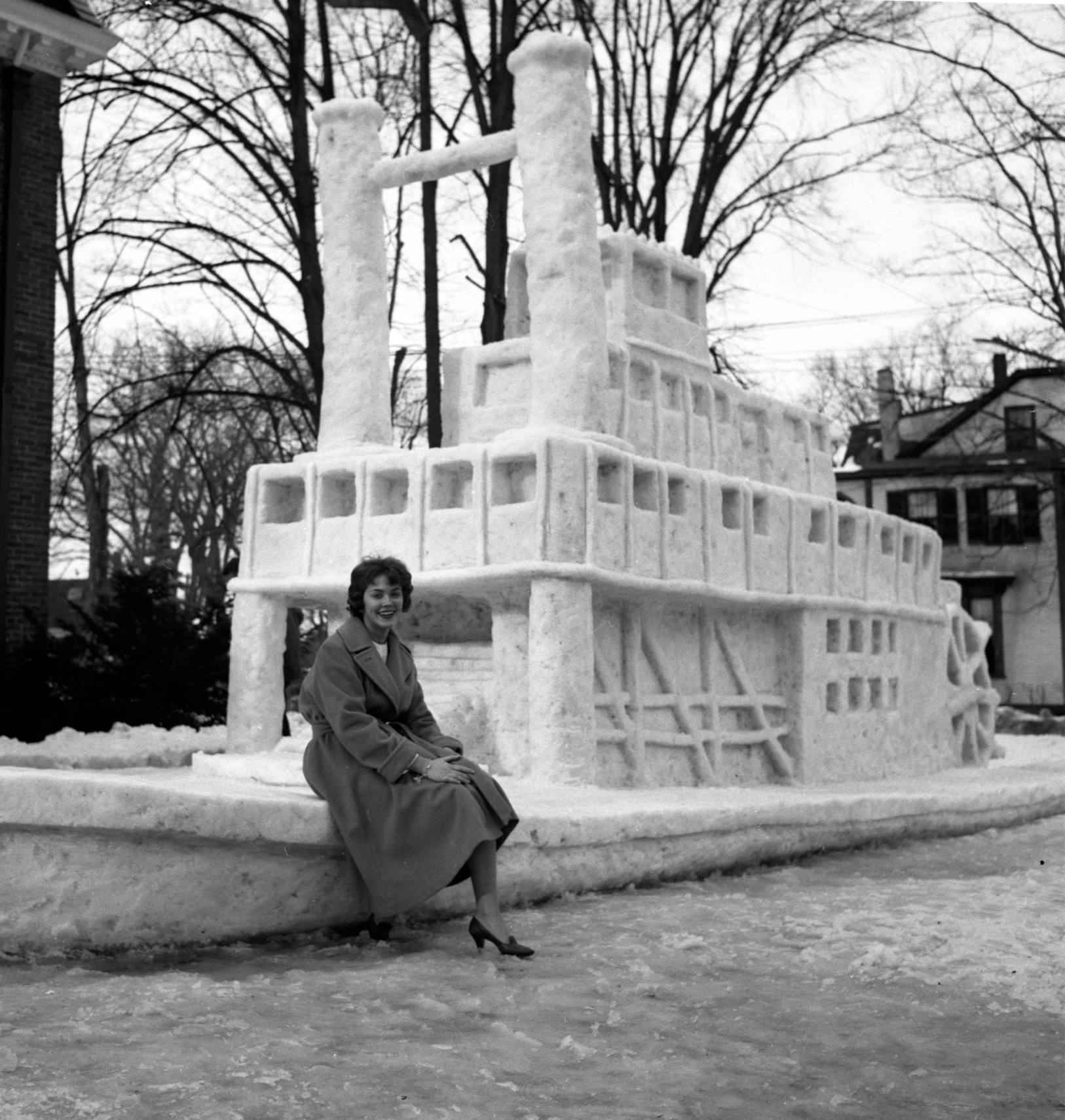
Snow sculpture contests were once a central feature of Bowdoin’s Winter’s Weekend, a broader college tradition in New England where students banded together to celebrate in the frigid months.
Alongside competitive broom ball, horse-drawn carriage rides, concerts, parties and other forms of organized chaos, students put on their winter gloves and carved art into the ground.
“The beginnings of snow sculpturing at the college level is vague,” a 1962 New York Times winter festival report wrote. “Dartmouth College, where it supposedly all started, claims only to have begun the practice in the early 1920s.”
Bowdoin soon joined what the New York Times dubbed the “icy art circuit,” and while the official start of the decades-old tradition is unspecified, Bowdoin Orient archives include articles mentioning the competitions beginning in 1945 and continuing on for decades.
“Zoological Memories of various snow statues linger on the campuses, either because of their tradition, or their unusual and imaginative nature,” the New York Times wrote. “A polar bear of great size was a feature at Bowdoin when this idea was young.”
Even as other activities died down over the years, the snow sculptures endured as one of the weekend’s most anticipated events for students, faculty and Brunswick citizens alike. Jed Lyons ’74 explained that during his time at Bowdoin, fraternities and student dorms would often choose a few first years to design their house sculpture, leaving them to brave the cold and turn the bounties of winter into a spectacle of campus pride.
In 1971, perhaps as one of his first celebrated works, American painter Stephen Hannock ’74 remembers joining in on the contest through his Psi Upsilon fraternity, which rejoined the competition that year because they “finally had an artist in the house.”
“We built a replica of the polar bear in front of the college athletic building [MacMillan House at the time]. Then, showing our remarkable maturity, I constructed another bear mounting our first bear. After they were finished, we added the red tongues to both,” Hannock wrote in an email to the Orient.
The lewd sculpture did not go unpunished, as some parents of Brunswick school kids lodged a complaint. Still, Hannock found a way to make a wholesome replacement.
“[Dean A. Leroy Greason] made it clear that I would no longer be playing hockey at Bowdoin if that sculpture remained,” Hannock wrote. “That is when my classmate Jed Lyons suggested I use the snow from the demolished adult polar bears to build a litter of cubs. We did just that…, and so they remained.”
Hannock insists his creation wasn’t even the worst of it.
“It should be duly noted that my polar bears were nowhere near as obscene as so many of the other snow sculptures that year. It’s just that those efforts were so poorly executed that they all looked like irregular piles of snow,” Hannock wrote.
 Courtesy of the George J. Mitchell Department of Special Collections & Archives
By the late 1990s, the snow sculptures had stopped as a marker of winter on campus. Archival records of the Orient indicate that the continuity ended due to the continued unseemliness of the artistry or due to the abolition of fraternities on Bowdoin’s campus in 1996.
Director of Student Activities Nate Hintze recalled students’ efforts in the 2000s to revive Winter’s Weekend on campus. An Orient article from 2013 recalled a “Winter Carnival,” with events including a concert featuring student artists and the traditional College House snow sculpture competitions on the quad. Similar events were also held in 2006, 2009, 2011 and 2013.
Hintze explained that the revival didn’t last as student interest waned and the pandemic impacted campus life. The tradition also seemed to come to an end because what bound Winter’s Weekend activities together ran out—the snow itself.
Professor of Constitutional and International Law and Government Allen Springer, who remembers the contest’s decline, recalled Facilities plowing large mounds of snow near the quad when snow was not available.
“Unfortunately, I think several years of limited snowfall made it difficult to continue the contests, especially since they had been timed to one particular weekend,” Springer said.
This is strikingly different from Lyons’ recollection of his time on campus.
“It was a winter wonderland all winter long. When I was there, I don’t think the snow melted until April,” Lyons said.
This issue reflects a broader trend of warming winters in Maine driven by the climate crisis. Multiple recent studies on climate impacts in Maine have found significant impacts on snowfall. A University of Maine study estimated a 17 percent decrease in the statewide average annual snowfall over the past century. The study also found greater variability between low and high snowfall winters.
“More and more, we seem to be experiencing ‘winter weather whiplash,’ with rapid shifts from freezing to thawing conditions, heat waves and rain in the depths of winter, and cold or snow in spring and fall when the leaves are still on the trees,” the study reads.
Members of the campus community have noticed these impacts and how they have affected campus culture surrounding winter events. Hintze noted the “winter weather whiplash” when discussing the demise of Winter’s Weekends in the 2010s.
“There were a couple of years where there just wasn’t any snow, or the snow was here for a short stint, and then there’d be a lovely 50-degree day, and then it would all go away,” Hintze said.
Unfortunately for snow enthusiasts, the trend is predicted to continue. A Maine Climate Council study predicts that New England winters will continue to warm, with fewer days of snow cover.
“Deep snowpacks will become increasingly short-lived, decreasing from a historical baseline of two months of subnivium (under the snow) habitat for organisms to less than one month under the warmer, higher-emissions climate scenario,” the study finds.
After last weekend’s storm, the Main Quad and paths surrounding campus had that same familiar look as many years before. With cold temperatures remaining, sculptures could still rise from the ground if only students were given a shovel and a day off. Whatever happens, let’s keep it classy.
Comments
Before submitting a comment, please review our comment policy. Some key points from the policy:
- No hate speech, profanity, disrespectful or threatening comments.
- No personal attacks on reporters.
- Comments must be under 200 words.
- You are strongly encouraged to use a real name or identifier ("Class of '92").
- Any comments made with an email address that does not belong to you will get removed.
How cool! Bring back the snow sculptures. It’s fun, it’s creative, and it gets students outside. Weekends coming! Time to get the creative juices flowing.