
Two birds
December 5, 2025
 Caitlin Panicker
The summer after my sophomore year, I shoot my first roll of film on Kent Island. I am forgetful with its presence, and every so often, I will remember its place in the second-floor bedroom I share with my friend and bring it back out into the light again, fidgeting with the aperture and shutter speed, two concepts I possess only a limited understanding of. The camera had been purchased at what I suppose was the advent of digital photography, then abandoned by my parents. It is a beautiful object, the kind of vintage that feels heavy in your hands and fills out space in memory aside intention.
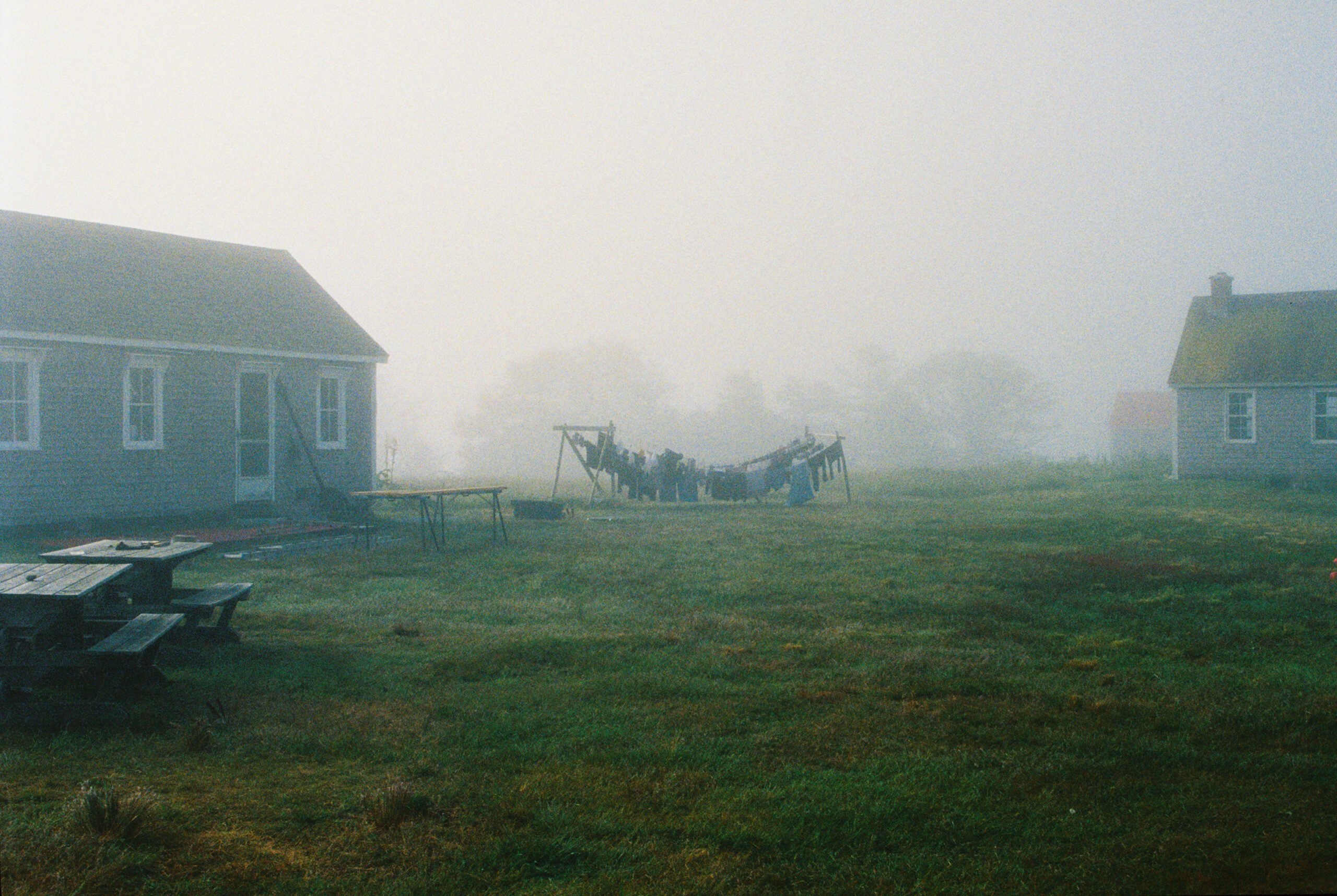
My nine weeks produce only 12 photos. The sinking clothesline on the front lawn is featured twice. It is first the primary subject on a backdrop of soft, dense fog on a Sunday morning, a muddle of shapes and singularly colored. The trees in Kent Island’s sparse, forested field appear as large, spindly creatures lined up behind a screen, stationary but in pursuit. The picnic tables sit unoccupied and close together. The lichen-carpeted roof of the warden’s house is a muddy yellow, the lawn still exuberantly green.
It is next the unwilling focus of a much more colorful photo taken at the cusp of sunset, clothesline centered behind slats of roofing left lying in front of the shop, and to me it is apparent that many of its clothes belong to the two young children inhabiting the island with us, their patterned pajamas and tiny socks. In this photo there is one gull on the roof and two in the sky—a hallmark of Kent Island and just about any island in this part of the Atlantic.
During my summer on Kent, I find that it is reluctant to shake hands with time, that each moment feels out of phase, a tap that fills you up without emptying its tank. The photos I take are sort of pretty and amateur. At the very least they are doused in sentimentality.
The flagship of Kent Island history is one Atlantic yellow-nosed albatross, whose discovery in the Bay of Fundy becomes the seminal moment around which a network of chance forms, one that will eventually drop the island into Bowdoin’s ownership. The yellow-nosed albatross is found exclusively in the southern hemisphere, and as such, the specimen found west of Kent Island should not have been there at all. I hear about this one small and errant bird several times without ever hearing the full story. The point made is that because this bird traveled north, I am here, traveling northwards as well.

Ernest Joy, a fisherman from nearby Wood Island, shot the albatross in the Bay of Fundy in 1913. The bird was preserved by taxidermist Allan Moses, who lived on the island of Grand Manan and owned a private museum there. His specimen was highly valued by collectors, chiefly the American Museum of Natural History, and so Moses traded it for the opportunity to join one of their expeditions to central Africa for specimen collection.
Moses left to seek out African bird specimens to condemn with an indefinite trip to the Museum of Natural History. Expedition leader J. Sterling Rockefeller desired an African green broadbill specimen to bring back to the U.S., but after several days of searching, the party was unable to find one. But when Moses fell sick and was forced to stay back at base camp, he saw and shot the bird outside of his tent. Rockefeller was so happy to have the specimen he purchased Kent Island and established it as a bird sanctuary for Moses, who had been watching settlers on the island unsustainably harvest its eider population for much of the previous century. Rockefeller later donated the island to Bowdoin.
The story is patterned by incidental encounters with extremely rare birds and exchanging favors in their wake. It is a little bit absurd, and otherwise entirely fitting, that Kent Island is made possible by two individual birds that, depending on how you look at it, were in the wrong place at the wrong time.


Joy and Moses each appear to shoot one bird first to save thousands in the next century, and second to draw Bowdoin’s population slightly northwards come late May. Joy is hired as the island’s caretaker in its first field season as property of the College in 1936, and that summer its student inhabitants produce at least three reels of film documenting scenes of island life that in their cracks and flickers resemble the days I spent there. Students collect weather data, watch a baby seal slide gently out to sea, line up impatiently for dinner and navigate a wooden rowboat toward a rocky shoreline.

I am particularly taken with one scene of a student chasing a young gull in circles around the beach, unmistakably on the east side of the island. The bird is nearly fledged but not quite, such that it unfurls and flaps its wings only once before turning around, and in this moment the boy pivots too, reaches down, envelops the bird in his hands. He holds it up to the camera proudly, the chick’s webbed feet kicking slightly. He sticks his index finger in front of its dark bill. The bird clamps down. The boy lets it stay there for a moment. The film cuts.
I have been there exactly, mired in the confluence of things that can bring a person to the east beach of Kent Island. The tide banks to my left, the birds scream slightly above my head and there is a gull in my hands.
Comments
Before submitting a comment, please review our comment policy. Some key points from the policy: