
Thoughts about Luna
December 5, 2025
 Mia Lasic-Ellis
When I was a kid, there were many things I was scared of. Steven Spielberg’s “Jurassic Park” (1993) was one of them—my mom tells the story of me coming downstairs crying because I thought the dinosaurs were going to eat me (I was apparently rocking back and forth, clutching my stomach and crying that I wished I had never seen the movie). Sharks were another one: especially the bull shark, which I learned could travel into freshwater and imagined would be waiting for me in the waters of Lake of the Woods in northwestern Ontario, where we would visit my grandfather’s cabin almost every summer. Another one was later, when I realized that I would die someday, which I had an epiphany about while reading about turtles in one of those Discovery Kids books, the shiny big ones with animals fanning out across the cover.
The last one that I particularly remember was werewolves. I have a vivid memory from this one book of monsters my family had lying around the house. A few pages after the chupacabra and vampire bat, there was one page with a particularly scary illustration of a man turning into a werewolf, his face lengthening into a canine snout as he raised his neck to the moon.
Every time I would see a full moon when I was younger, I would think about them, and a full yellow moon scared me a couple times in the same sense you would be scared looking out into a dark hallway at night, because obviously monsters aren’t real, but there is no way of knowing what’s out there beyond the light. (This also happened to me when I was younger.)
Now that I’ve gotten to the ripe old age of 19, I know that werewolves aren’t real. But every time I see a full yellow moon, I still remember them. “Watch out for the werewolves tonight,” I’ll joke with friends, and occasionally jokingly howl at the moon on nights when it is particularly full.
I still think about the moon a lot, though.
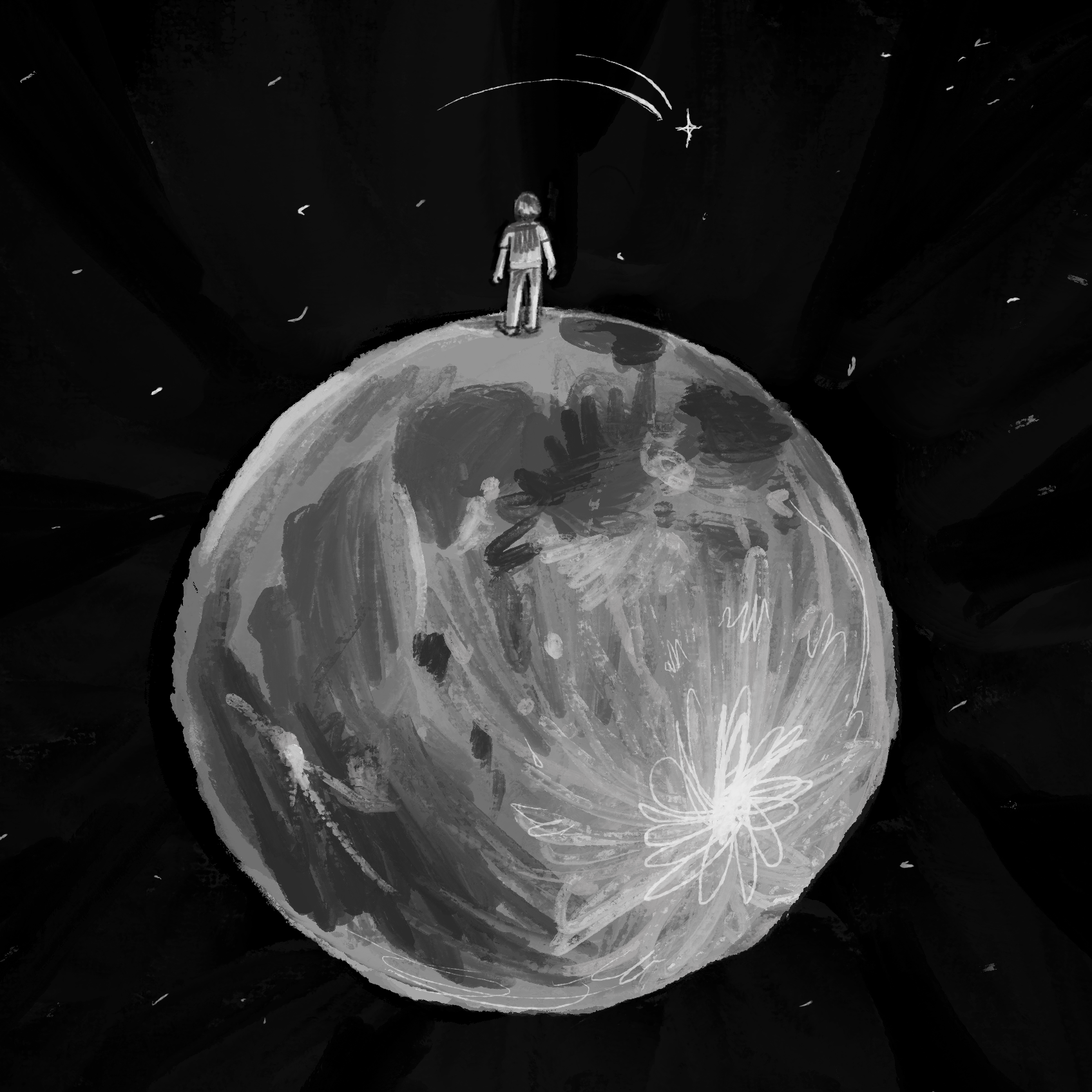
Over last year’s spring break, I was running down my usual route, down a road that runs between an estuary and the Long Island Sound to a parking lot at the end. On my way back, I remember looking up into the clear blue sky and seeing the moon, nearly full, hanging in the air. It hit me then: If the moon is that far away, and yet it’s still so visible, it must be massive. (After taking astronomy this semester, I have learned that it, in fact, is—the radius of the moon is nearly 2,000 kilometers. But that’s besides the point.) When I thought about it more, isn’t it crazy that you can see the moon, a big floating piece of rock in the sky, from hundreds of thousands of miles away?
That day, I remember thinking about how small I was in comparison to the gargantuan size of the Earth, the moon and the rest of the universe. I had felt awe in the face of nature before in places as varied as the Appalachian Trail, the Grand Canyon and the rolling expanse of western Canada. I had felt it in afternoon drives over the hills of Maine, a gray sunset in New Mexico’s Sangre de Cristo mountains that exploded with color, pink sunsets on the Connecticut shoreline and the Bay of Fundy’s tides. But I hadn’t felt the sheer scale before as much as I did that one chilly March day.
This realization brought others. If the world is so massive, what does this mean for us puny humans? Maybe there is no meaning to life because we are so inconsequential that nothing we do ourselves could truly matter. Maybe there is a meaning—maybe it’s touching the lives of the people around us, no matter how vast the world might be. I’d like to think it’s the latter, but I don’t know for sure. No matter how many thoughts it brought upon, the moon sparked a moment of clarity, driving home for me the awe of nature that it and the rest of the world deserve.
In my life, the moon has been the place where I have seen scary childhood myths play out—myths of muscular men who puff their chest outward and rip their shirt in two as gray hairs appear all over their bodies. It has also been a place of clarity, making me realize the true size of nature. This one object, the moon, has shown me two different extremes: superstition and lucidity.
This isn’t to say that one is better than the other. I know now that werewolves are not real, and I know now that I am simply so small before the vastness of nature. I know that the latter is an important realization. But myths of my childhood—like werewolves—provide a link to the past, something to reminisce about with friends or family. So if you hear somebody howling at the moon one night, at a time when the gargantuan chunk of rock hanging in the sky is particularly round, don’t be scared—it just might be me.
Comments
Before submitting a comment, please review our comment policy. Some key points from the policy: