
Ghosts of Bowdoin’s literary past
December 5, 2025
 COURTESY OF SPECIAL COLLECTIONS AND ARCHIVES
Bowdoin’s literary past holds an abundance of hauntings. Some of these ghosts are simply due to Bowdoin’s location—an old, remote college where the sun sets early and the woods cover most of the state. The College also has a collection of prolific writer alumni, including Nathaniel Hawthorne and Henry Wadsworth Longfellow as the best-known.
Professor of Africana Studies and English Tess Chakkalakal finds that the history of these alumni and their friendships have a way of haunting the present literary and academic world. These friendships were built not only through activities like hunting and fishing, but also, through the sharing of writing between different students.
“I have this line that I tell my students in my Introduction to Early American Literature class that Bowdoin College is the birthplace of American literature,” Chakkalakal said. “Because there was this lively community in the early 19th century here, and the way they studied literature, the way they formed their friendships, [was] so important to how American literature developed.”
She particularly emphasized the importance of Hawthorne’s friendship with former President Franklin Pierce, as well as the mythologizing involved in their legacy.
“In fact, [the story of their friendship] might be a myth that they themselves created because it was conducive to Pierce’s political campaign. Hawthorne wrote a campaign biography for Franklin Pierce, and in that book, he creates a myth about who Franklin Pierce was,” Chakkalakal said.
She also noted that these students had a vast influence on the College’s literary culture even after their graduations. Both Longfellow and Calvin Stowe, Harriet Beecher Stowe’s husband, became librarians at Bowdoin after they graduated.
“[Longfellow and Calvin Stowe] were really important to forming the literary culture of the College. That’s what really helped them make these connections. It was really through the literature they were reading and writing,” Chakkalakal said.
Associate Professor of English Emma Maggie Solberg found that part of this literary history’s haunting lives within the ubiquity of these writers throughout the College.
“It’s all over the campus … how their names are engraved in stone all over,” Solberg said. “That feels like a haunting or a memorializing, even if we students aren’t super aware of it. The names of things are written in stone all over this campus, and we walk on them and we see them and we lean on them and they become part of us, right?”
Chakkalakal and Professor of English Brock Clarke also co-host a podcast titled “Dead Writers,” where they explore and speak about the houses and legacies of historical American authors. Chakkalakal finds that the haunting qualities of these houses exist less from actual ghosts, but rather, how well preserved these houses have been kept since their owners’ deaths.
“The houses that we visited felt like the people who lived there were still very present.… For us, there weren’t any actual sightings, but these houses were preserved to kind of keep alive the memories of the famous writers who lived there,” Chakkalakal said.
Secretary of Development and College Relations John Cross ’76, who often writes about unfamiliar pieces of history from the College, takes a more historical and skeptical approach to ghost stories.
“For all the elements that might be part of a ghost story at Bowdoin…, there are surprisingly few such narratives,” Cross wrote in an email to the Orient. “A number of people have experienced unexplained or unsettling events on campus…. I do not question the lived reality of these experiences, although I tend to be skeptical that these incidents necessarily constitute evidence of haunting.”
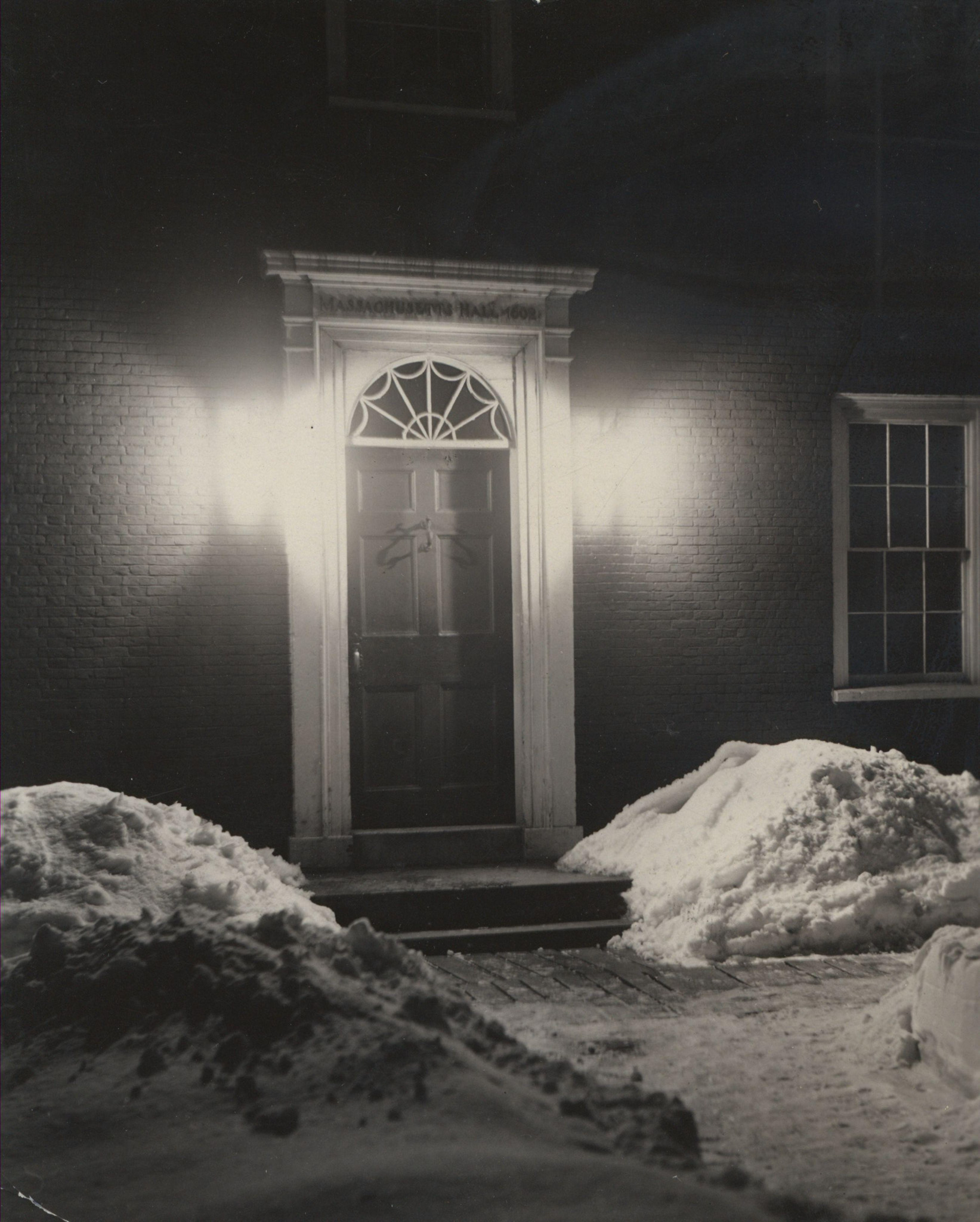
Solberg, though, has noted more literal hauntings at the College, particularly in Massachusetts Hall. Though there is no concrete ghost story associated with the building, Solberg, as well as her students, still find it holds a distinct spookiness, especially the third floor faculty room.
“I’ve heard [about] screams during silent movies up in that faculty room with first year students.… I turn [a silent movie] on, I go home [and] I leave them there,” Solberg said. “I definitely had cohorts of students completely freaked out from weird sounds in the building. The whole building creaks. It sounds like a chair moving up there.”
Solberg found many of her favorite Bowdoin ghost stories on the Haunted Bowdoin Tour, an activity led by Senior Interactive Developer David Francis over Family Weekend. Solberg found that, among the crowds of parents, students and children, the participants by and large accept the tour as fact. Some of the students even asked where they should study to remain unhaunted.
“Everybody just believes everything [Francis] says. No one is standing there questioning a word that man has to say,” Solberg said.
She further recalled a story Hawthorne wrote titled “House of Seven Gables,” inspired by his cousin’s house in Salem, Mass. The story takes place at the time of the Salem witch trials and spins the tale of the Pyncheon family wrongfully seizing a plot of land to build a house. The rightful owner of the land was later executed for witchcraft, and cursed the Pyncheon family. His novel reflects his own family’s actual struggle with a house. At the time, the family name was “Hathorne,” but Hawthorne changed his name to include a “w” upon arriving at Bowdoin.
“He was trying to escape the curse, and he changed his name to ‘Hawthorne’ and then wrote this text as an act of reparation or apology to the victims,” Solberg said.
Last year, Isabelle Lee ’25 wrote her honors project on the literary and historical legacy of witches, and through this project, she visited Salem. Lee noted that ghosts can represent an interesting stretch of time, where both the past can influence the present and the present can influence the past.
“The very different physical interpretations that you can get of the ghost is really interesting,” Lee said. “That also reflects how society and culture feels about ghosts and these characters. It’s this loop where society and history and people affect how we think about ghosts and then they get this expanded identity. And then, in turn, [ghosts] keep affecting people.”
Comments
Before submitting a comment, please review our comment policy. Some key points from the policy: