
A look at superstitions and rituals in athletics
December 5, 2025
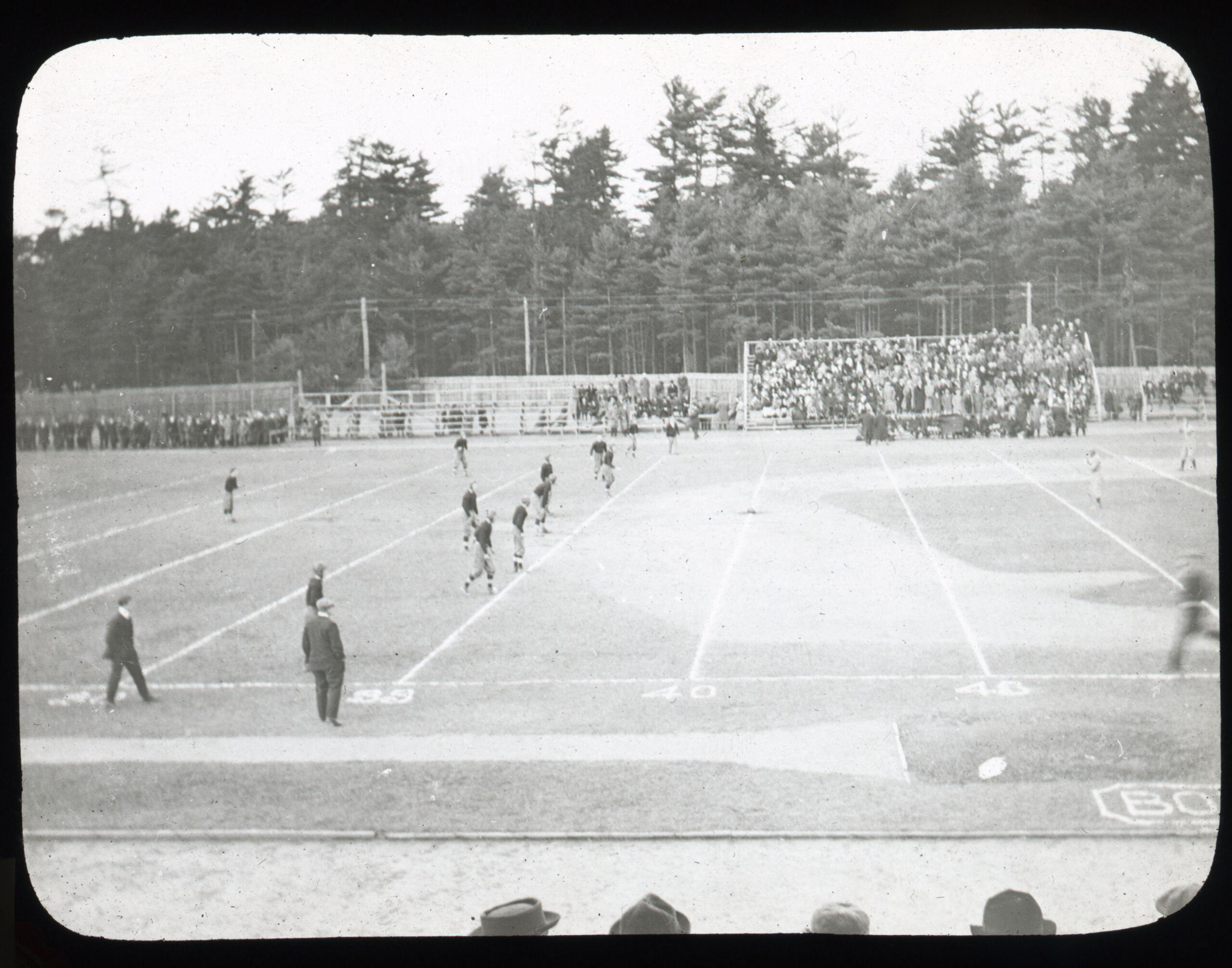 Courtesy of Special Collections and Archives
While founded in 1794, it took over seventy years for the college to found its first varsity athletic team—the baseball team, established in 1867. Three decades later, the football team played its first season in 1899. From 1794 to the present day, the Bowdoin community has adopted pregame rituals and beliefs that shape athletic culture across teams.
Bowdoin’s “Go U Bears!” chant unifies athletes and fans alike to support their team. Bowdoin’s mascot was chosen in the early 20th century after Bowdoin alum Robert Peary, Class of 1877, led several expeditions to the North Pole and recorded his sightings of Arctic animals, one of which was the polar bear. Back in Brunswick, the athletic department had been debating a mascot. With news of Peary’s findings, they chose the polar bear to represent perseverance, strong will and determination.
Ahead of the 1970-71 men’s ice hockey season and its tenth annual Eastern College Athletic Conference (ECAC) Holiday Hockey Festival at Madison Square Garden, Mary Ellen Good, sister of Edward M. Good ’71, had been making buttons for her family to support the Polar Bears on the ice. Some buttons said “Go Polar Bears Go!”, but Mary Ellen Good didn’t want to overcrowd the small button. Instead, she inscribed “Go U Bears!” on her buttons—and the saying caught on. Mary Ellen Good’s words of encouragement worked. Her brother led the ice hockey team to its first ECAC Division II championship that year and in 2016 was inducted into the Bowdoin Athletics Hall of Honor.
In addition to the “Go U Bears” chant to spread luck to players, teams at the College have also developed their own rituals and traditions over the past century. The field hockey program walks out onto the field to “Sunday Bloody Sunday” by U2, possibly fueled by its four national championships in seven years during the late 2000s into early 2010s. Field hockey goalies have also developed their own unique rituals over the years. Current netminder Lauren O’Donald ’26 recently articulated her pre-penalty corner routine for a Bowdoin Orient article.
“I give the right trail a stick tap or a high five. I give the post player one as well, and then I get a high five from the left trail. Then I step into the net,” she said.
Superstitions in athletics extend to the sports venue itself. When the men’s ice hockey team plays a home game in Watson Arena, they slap a sign when walking out of their locker room that reads “Defend the Sid” for Sidney J. Watson, the rink’s namesake. Similarly, the women’s ice hockey team bops a plush polar bear on the head for good luck before they get on the ice for their warm ups.
The two-time defending NESCAC champions of Morrell Gymnasium, the women’s basketball team, have a few superstitions of their own.
“My teammate and I have to be each other’s last high five after the dynamic warm-up,” Carly Davey ’26 said.
Other superstitions rely on uncontrollables or the opposing team.
“During warmups, the last shot that I see the other team take has to be a miss, so I have to keep looking over until I see them miss a shot and then not see them make another one afterwards,” Kate Saccaro ’28 said.
Director of Athletics Tim Ryan supports the women’s basketball team in his own way: by eating breakfast at the Brunswick Diner every gameday. The team’s constant wins can be attributed to either Sydney Jones’ ’25 three pointers or Ryan’s scrambled eggs. In a similar vein, volleyball Head Coach Erin Cady and Assistant Coach Taylor Stevens allegedly ate a lobster roll ahead of every match in 2021, the season the team went 23–5, won the NESCAC championship and appeared in the Division III tournament.
This past semester, Ryan wore his white short-sleeve jacket to watch a cluster of Saturday games—and a handful of teams that day ended up winning. The following weekend, he wore the same jacket to keep the series of successes going. While watching games, Ryan also changes his spectating position depending on how well the team is playing. He will often walk to a different part of the field if a team is not playing well. Even while watching games on his computer, he will wheel his chair farther and closer from the computer.
“I always had little things I did when I was playing at Bowdoin, such as listening to the same pregame music, wearing a t-shirt from high school under my college uniform and sitting in the same place in the Whittier locker room,” Ryan said. “Now as an athletic director with little control over what happens during our games, I find myself standing in the same spot, crossing my arms or holding my hands behind my back and eating the same meal several days in a row if our teams are on a winning streak, as a way of convincing myself I may be able to help our athletes while they are competing.”
With a history of outstanding athletic performances over a century of competition, Polar Bear history steeped with superstition may be to thank.
Comments
Before submitting a comment, please review our comment policy. Some key points from the policy: